
Fields in Lenawee County Property Tax Records
Three offices split the work in Lenawee County. Local assessors and County Equalization build the parcel identity and the value framework. The Treasurer handles current and delinquent tax status. The records relate to each other, but their dates rarely match. Keep the tax year, assessment year, municipality, and Tax ID attached to anything you save. A number pulled loose from those labels can mislead you later.
| Field | What It Shows | Where |
|---|---|---|
| AV, SEV, and TV | Assessment values used in Michigan's tax system | Local assessor and BS&A |
| Ratio and factor | Relationship between assessed and true cash value by class | County Equalization report |
| Current tax account | Current charges and public payment information | BS&A and local unit |
| Delinquent status | County-held unpaid tax and foreclosure stage | Lenawee County Treasurer |
| Tax ID | Stable key joining tax, assessment, map, and deed leads | All county property systems |
A tax amount is not a sale price. An assessment figure is not a private appraisal, either. Michigan assessment terms also carry meanings that differ from everyday real-estate language, so read the definitions and the report year before comparing one Lenawee County parcel against another.
Search Lenawee County's BS&A Tax Portal
The county's BS&A portal takes three search keys that hold up against spelling and address variations, which makes it a practical first stop. Its public menu splits into Assessing, Current Tax, Delinquent Tax, and Detailed Record Search. A basic search may cost nothing, while the full detail card can sit behind an account or a payment gate.
| Search control | Input | Practical use |
|---|---|---|
| Address | Street or address range | Begin when the Tax ID is unknown |
| Name | Owner, often surname first | Find parcels tied to a known taxpayer name |
| Parcel Number | Full hyphenated Tax ID | Best key for a specific account |
| Search Focus | Assessing, current tax, delinquent tax, detail | Keep unlike record types separate |
The county allows owners to claim up to five properties at no charge. A sample detail action showed a $6.95 access price, so check the live screen before you pay.
Free Search and Paid Detail in Lenawee County
The Treasurer's Real Property Tax Search lists no search fee, with detailed information at $3. The county also will not disclose property information to third parties by phone. Does the public search not answer your question? Use the online record, write, or visit the counter.
Find the Treasurer at 301 N Main Street in Adrian. Counter hours run Monday through Friday, 8 a.m. to noon and 1 to 4:30 p.m. That office handles delinquent taxes. A parcel-specific assessment question starts instead with the city or township assessor.
Note: Save the result's year, municipality, and Tax ID. An unlabeled screen can be mistaken for a different tax cycle.
The county's tax-search instructions show the access terms before anyone enters the system.
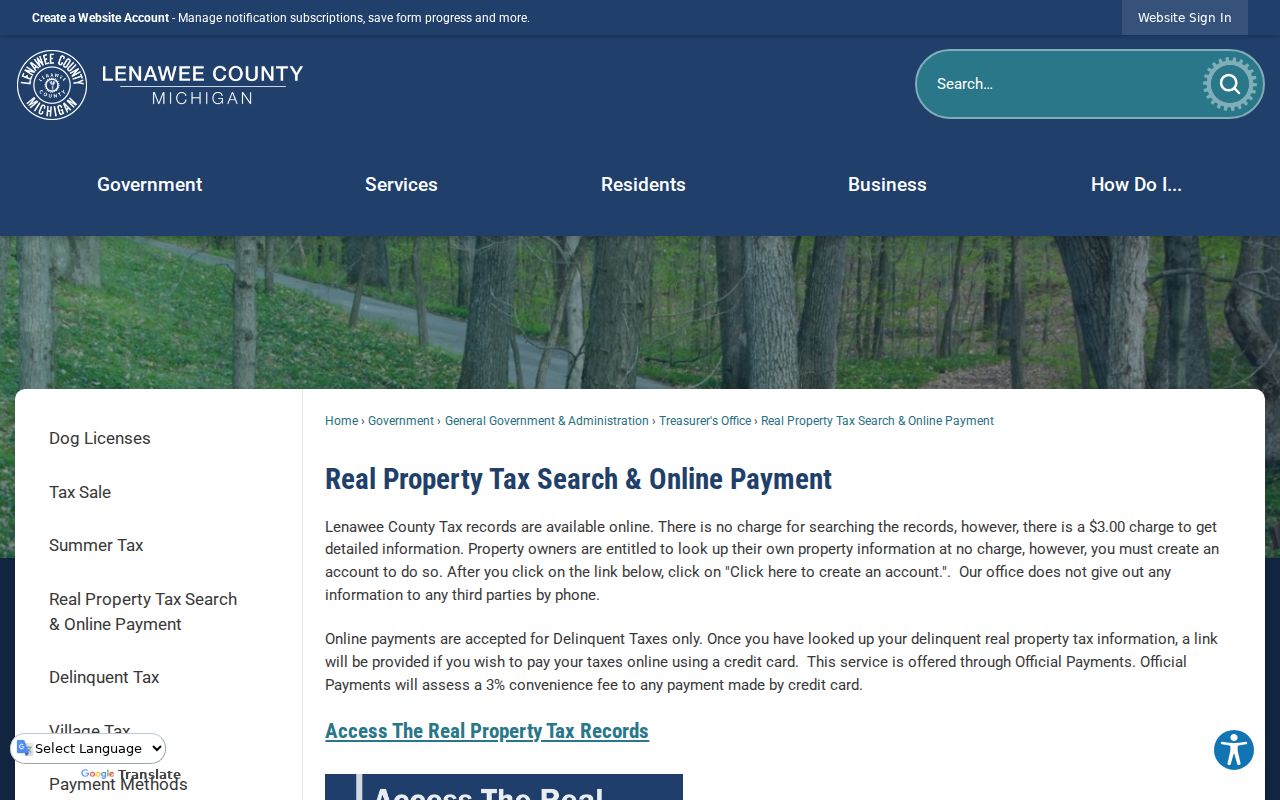
The official Treasurer page matters because it separates a free lookup from paid detail. It also states the county's phone-disclosure limit in plain terms.
Follow a Lenawee County Tax Account
Start a Lenawee County tax lookup with identity, not the balance. Confirm the address and Tax ID first. Then choose the correct assessment jurisdiction and tax year, and keep current local taxes separate from county-held delinquent taxes rather than blending them into one number.
- Search BS&A by address, owner, or the full Tax ID and verify the municipality.
- Select the current-tax service for the year and record the status shown.
- Use the county delinquent-tax route if the local account directs the debt to the Treasurer.
- Check the assessment roll separately for AV, SEV, TV, and any verified classification.
- Contact the named local assessor for parcel-specific value questions.
- Assessed value
- The local assessor's value before county and state equalization.
- SEV
- State Equalized Value after required equalization.
- Taxable value
- The value used with millage to calculate property tax, subject to Michigan rules.
- Tax lien
- The public claim created by unpaid property tax.
Equalization Across 26 Lenawee Jurisdictions
Equalization work in Lenawee County ties together 26 separate assessment jurisdictions. Each year the department's report recommends an equalized value for every property class. It covers each city and township. The core of the process is a ratio. It measures local assessed value against true cash value. A 48 percent ratio, in the county's own example, sits below Michigan's 50 percent assessment level. It calls for a factor. A ratio of 50 percent yields a 1.00000 factor instead. The Equalization page presents this ratio and factor explanation next to the annual reports.
The 2026 Equalization Report and the L-4028 materials are specific to a single year. They lay out the countywide framework built on MCL 211.34 and MCL 211.34a. Even so, they cannot substitute for a local assessment card or a parcel appeal. For that level of detail, County Equalization points property owners elsewhere. It directs them back to the local assessing office.
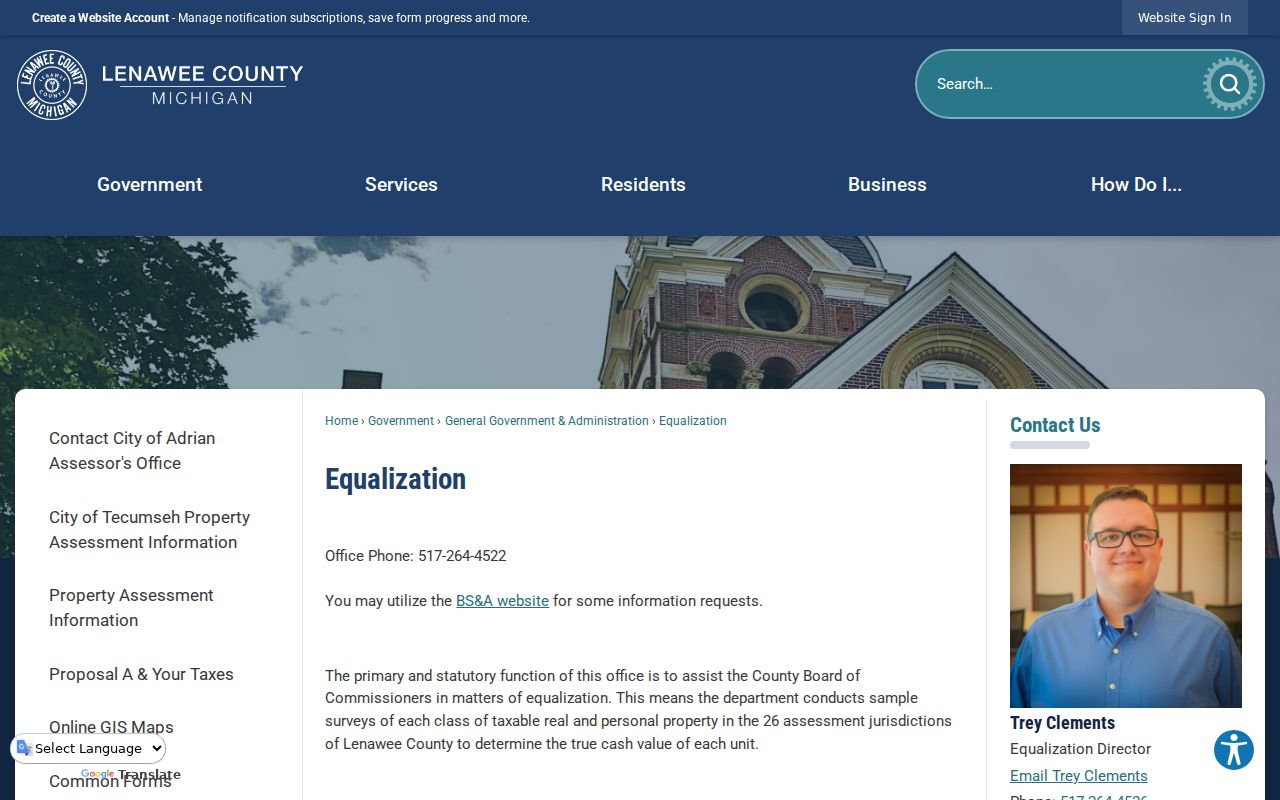
The report year and property class drive any reading of a Lenawee County assessment figure.
When Lenawee Taxes Become Delinquent
The county's Delinquent Tax page walks through penalties, forfeiture, foreclosure, notice, and hearing stages. A credit-card payment through the named processor carries a 3 percent convenience fee. Confirm the parcel and the amount before you submit anything.
The Tax Sale page listed a Zeus auction for August 11, 2026. Registration and payment dates cluster around that sale date. Those dates expire and never carry over to another year. Sale parcels can be withdrawn, are offered as-is, allow no walkthrough, and carry title-insurance warnings. Treat the sale list as a time-sensitive administrative record. It is not proof that a parcel is still available.
A Parcel Split Creates a New Tax Trail
Lenawee County's Tax-Deed Certification procedure documents a useful exception to ordinary searching. For a land split, the applicant starts with the city or township assessor, submits a certification form with the parcel number and legal description, and pays $5 even if the request is denied. The finished certification then goes back to the assessor.
This is why an old Tax ID may fail to retrieve the current parcel. Keep the parent parcel, the new suffix, the legal description, and the certification date as a crosswalk. The GIS map and the deed Liber/Page can then show whether the apparent gap is really a split rather than a missing tax account.
Lenawee Tax Records by Access Channel
Digital tools are just one channel among several. For identifying a municipality and Tax ID quickly, the BS&A menu works best. The Treasurer's web page handles both current and delinquent searches. A detailed record there may carry the published $3 charge. An owner account can claim up to five parcels at no cost. The portal sometimes leaves a question open. The Treasurer counter at 301 N Main Street then takes in-person inquiries during its split weekday schedule. The county does not disclose third-party property information by telephone. Written requests are therefore the practical fallback.
Assessment issues run through a separate office. Contact the city or township assessor named on the parcel first. County Equalization then covers class ratios, factors, annual reports, and countywide mapping. A missing assessment-roll entry can be pursued through a narrow FOIA request. The same route fits a parcel-history cross-reference, land-split certification, or layer-update record. Cite the Tax ID and date in each case. Ask for electronic delivery and a fee estimate. Michigan FOIA allows search, review, separation, copying, and mailing fees. The county may also require a deposit when its estimate tops $50.
Each channel yields a different document. A portal result is not a certified tax statement. An equalization report is not a parcel decision. A payment receipt is not a title record. Record the office name, query date, tax year, and parcel number. Note the fee status too. Also note whether the answer came from a public screen, a counter copy, or a written response.
Forfeiture, Foreclosure, and Lenawee Tax Status
An unpaid account moves through stages. The label shown on the search date matters. County delinquent-tax material separates delinquency, forfeiture, foreclosure, notice, hearing, and county ownership. A parcel sitting in one stage should not be described as sold. Check the Treasurer's current page. Also check the court or notice record tied to that parcel. Draw no conclusion before reading both.
The 2026 Zeus sale shows how time-sensitive this material is. Registration ran from July 10 through noon August 10. The auction was August 11. Payment was due by noon August 13. Minimum bids had stated inclusions and exclusions. Parcels could be withdrawn, bidders received no walkthrough, and property was offered as-is. The county also warned about deed timing and title insurance. Those dates document 2026 only. Any later search should replace them with the live year's notice.
Surplus proceeds follow a defined county process rather than passing automatically to a former owner. Anyone with a parcel-specific interest should read the current notice. Obtain legal advice. Do not trust a portal status label. Note: A delinquent balance, forfeiture entry, foreclosure judgment, auction listing, and issued deed are separate events. Each has separate dates and proof.
Contest a Lenawee County Assessment
Start with the local assessor named for the parcel. County Equalization does not decide an individual property's value. Compare the assessment notice against the property card, verify the correct Tax ID and classification, and assemble dated evidence covering the land, improvements, condition, and comparable sales. Ask the assessor which current form and meeting date apply.
Appeal window. Lenawee County describes tentative ratios before the March Board of Review, but the research did not capture each municipality's current dates. Verify the local notice before relying on a deadline.
After Board of Review action, the county report moves through county-board approval and then submission to the State Tax Commission. Keep the appeal receipt and decision filed with the assessment year. For a plain-language comparison of AV, SEV, TV, and sale price, turn to the Lenawee County property value guide.