
Compare Lenawee County Property Value Types
Every Lenawee County property value field answers a different question. Label each one. Keep values and their dates in separate columns, because a shift in taxable value says nothing about a building's sale price or its condition.
| Value | What It Is | Where |
|---|---|---|
| Assessed Value | Local assessor's value before equalization | Assessment roll |
| State Equalized Value | Assessed value after equalization | Assessment roll |
| Taxable Value | Value used with millage under Michigan rules | Assessment and tax record |
| True cash value | Michigan's market-value concept | Assessment analysis |
| Last sale consideration | Amount tied to an earlier transfer when recorded | Deed or transfer record |
Michigan aims its assessments at half of true cash value before equalization. That target keeps the rolls uniform; it does not turn an assessment into an offer, an appraisal, or a prediction of price.
Find Lenawee Values in BS&A
Lenawee posts its values in the county BS&A portal. You can search by address, owner name, or parcel number. Tabs separate Assessing, Current Tax, Delinquent Tax, and Detailed Record Search, so open the assessing record for a value's meaning before looking at an amount due.
| Field | Format | Use |
|---|---|---|
| Address | Situs or range | Find a parcel without its ID |
| Name | Owner spelling | Find accounts tied to a name |
| Parcel Number | Full Tax ID | Open one exact parcel |
| Search Focus | Assessing or detail | Keep value and bill views separate |
Pulling a detailed card can require an account or payment; the portal charged $6.95 for access to sample records. Owners of record can claim up to five of their own parcels free.
Read Lenawee Ratio and Factor Reports
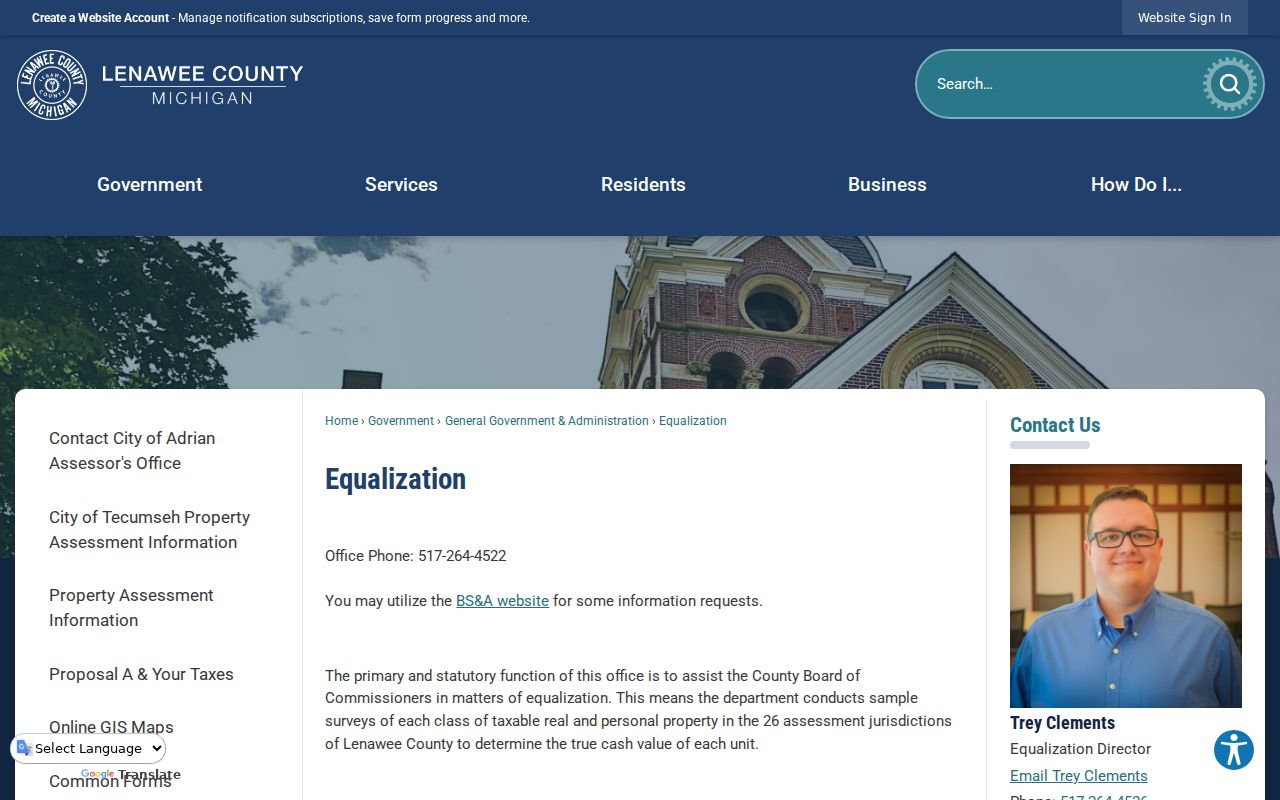
County Equalization coordinates 26 local assessing jurisdictions. Its annual reports compare assessed value with true cash value for each property class. A 48 percent ratio falls below the required 50 percent level and needs a factor, while 50 percent produces 1.00000. The official page posts links to each annual report.
Each posted ratio and factor report covers a single year. The 2026 figures do not carry forward; check the new publication before reusing any number.
Why Lenawee Values Change on Different Clocks
Local assessors keep parcel values. County Equalization reviews whole classes and jurisdictions. Deeds capture transfers, and GIS maps the Tax ID. Those systems refresh on their own schedules, so a sale can be recorded before the assessment card ever changes. Note every date you touch: assessment year, transfer date, recording date, portal certification date, and map update date. Without those labels, a fresh deed price gets compared with an older tax roll as if both described the same moment.
Look Up a Lenawee County Assessed Value
Start any value question with the parcel number and its local assessing unit. County Equalization sets the framework, but a specific parcel's value goes first to the city or township assessor.
- Search BS&A by address and confirm the Tax ID and municipality.
- Open the assessing view and record AV, SEV, TV, and their year.
- Check the annual county ratio and factor for the proper class.
- Use the latest recorded deed only as a separate sale reference.
- Ask the local assessor for parcel-specific valuation evidence.
- Assessment ratio
- The relation between assessed and true cash value.
- Equalization factor
- A multiplier used to bring a class to the required level.
- Reassessment
- The assessor's new review of parcel values for a cycle.
- Consideration
- The amount stated for a transfer, subject to the record's context.
Sale Price Is a Separate Lenawee Record
The Register of Deeds records deeds and land instruments. A consideration figure means little alone. Read it with the recording date, deed type, parties, and legal description, since a nominal or non-market transfer is not a comparable sale. For document hunting, Lenawee Public Search accepts grantor and grantee names, subdivision, document type, document number, dates, and OCR scope. It runs deep. One caution: the portal's current certification marker does not guarantee complete historic images online.
Parcel Splits Complicate Lenawee Value History
Splits scramble Lenawee value history. A parent parcel and its new suffixes can carry values from different years. The county's land-split tax certification asks for the parcel number and legal description. The $5 fee applies even when the request is denied. A current Tax ID may fail against an older deed. Build a crosswalk of parent and child IDs and legal descriptions. Add plats, Liber/Page references, and dated values. Confirm splits with the assessor or a recorded instrument.
Separate AV, SEV, and TV in Lenawee County
Michigan assessment records carry three distinct figures. Assessed Value is the local number before equalization. State Equalized Value reflects the equalization process. Taxable Value pairs with millage to compute the tax bill and follows its own state rules. Do not relabel any of these fields as market value. County Equalization publishes ratios and factors by jurisdiction and class after local Board of Review action, county-board approval, and submission to the State Tax Commission. MCL 211.34 and MCL 211.34a frame that sequence. The county report stays a class-level record; for one property's numbers, start at the local parcel card.
Improvements and Land in a Lenawee Assessment
A Lenawee assessment splits value between land and improvements. Mass appraisal produces those figures from property characteristics and local inspection practice. The county posts no full public detail-card inventory. Never promise fields the live parcel lacks. Ask the local assessor for the record. Plenty stays invisible in a public value line: physical condition, deferred work, easements, contamination, private sale terms. GIS aerials and topography provide context only. A permit file documents work in a city; a deed documents transfer. Neither proves the assessor folded that fact into the current value.
Recent Sales and Lenawee Recording Lag
One sale creates several dates. Agreement, closing, recording, roll update, and later tax treatment all march to their own clocks. Keep them apart. Lenawee Public Search carries a certification-through date, and county ArcGIS layers posted their own May and July 2026 updates. Neither system date tells you when a particular assessment value changed. Read consideration only after the deed type and context. Related-party transfers, estate distributions, quitclaims, land contracts, and nominal consideration rarely reflect an open-market price. A single past transfer is not today's appraisal.
Access a Lenawee Value Without the Detail Gate
Start with the free BS&A search. Note the Tax ID, the local unit, and the values shown there. Detail can sit behind a gate. An owner can take the parcel-claim route the county describes in that case. Other users can weigh the current fee. They can also visit or write the local assessor, or request a defined public assessment-roll entry. The Treasurer gives no third-party property data by phone.
Need a countywide report or mapping? Contact County Equalization at 301 N Main Street, 517-264-4522, or equalization@lenawee.mi.us. Parcel-specific questions go to the local assessor first. A question like why an assessment changed belongs to that municipal office. That office identifies the current card. It can also explain the inspection basis, the review notice, and the appropriate record request.
Use Lenawee Value Evidence for Review
Start with the exact notice and assessment year. Check the characteristics, classification, and land and improvement details the local record actually provides. Add comparable sales from a relevant period. Keep dated repair evidence, surveys, photographs, and recorded restrictions. Include them when they bear on the assessor's stated method.
The county publishes tentative ratios before the March Board of Review. Local dates and forms vary across Adrian, Tecumseh, Hudson, and the townships. Get the local notice and deadline. For the tax bill, continue to the Lenawee County property tax records guide. It also covers the fuller review path.
What Lenawee County Property Value Cannot Prove
An assessor value serves public assessment administration. It does not certify condition, settle title, fix a boundary, or guarantee a sale price, and asking prices and private estimates are not county records. A sale price reflects one dated transaction.
Value is not price. A Lenawee assessed value is not what a parcel will sell for and is not a licensed appraisal.
Use a survey for boundaries. For recorded-interest questions, a title professional is the right resource, and for the tax account, exemptions, delinquency, and the review route, continue to the Lenawee County property tax records guide.